

I suspect that much of this blog will feature my dog Mabs, so I thought perhaps I should introduce her.
Back in April 2023, I lost my beloved old dog Sheba at the age of almost 15. I hadn’t intended to get another dog straight away, hadn’t intended to get a puppy and certainly hadn’t intended to get a dog with issues. And so, a mere month later, on the Dogs Trust website, I was quite smitten by a certain “Mabel”, who turned out to be a 5-month old border collie pup with a list of issues as long as your arm.
The picture above was one of the ones on the Dogs Trust website.
When I went to meet her and pick her up, it was made clear to me that Mabel was very nervous of people and reactive to traffic, but I felt that I could cope with that. After all, my old Sheba hadn’t been an easy dog when I first got her, but a lot of love and patience helped her to become a truly delightful dog.
And indeed, it was the case that Mabel was extremely nervous of people, including me. But she came home with me (one of my neighbours had driven me over to the Dogs Trust) and we started what has so far been a very long, sometimes very hard and frustrating, but ultimately very rewarding journey.
But first things first. I really didn’t feel like walking around the parks calling “Mabel”. Not the name for a collie at all! So Mabel became Mabs.
Over the next few weeks, it became clear that Mabs had issues that went far beyond the normal difficulties of a nervous puppy. Most seriously, she would lunge and snap at passers-by as we were walking along the pavements, she would lunge and snap at passing cars and she would try to nip visitors to the house. But she also had some very peculiar compulsive behaviours. When she was anxious about something, she would run around the garden snapping at imaginary flies or pouncing on the grass and tearing chunks out of the lawn. She was also completely unable to settle and rest during the day. Most painfully, she used to try (sometimes successfully) to nip my arm or elbow to stop me from using any tool or implement (including kitchen utensils and knives). She would also try to attack the guitars if I tried to play them. And these problems are just some of the difficulties we faced. And all of it alongside perfectly normal puppy behaviour such as stealing toilet rolls or shoes and, of course, toilet training.
Gradually, it began to dawn on me that Mabs was far more nervous of men than she was of women, which, being that I am a single man, was a little alarming. Her behaviour with passers-by was by far the most worrying, so I decided that I needed help and turned to the behavioural team at the Dogs Trust. (If you rehome a dog from the Dogs Trust, you have free behavioural support for life, which is quite wonderful.)
I just paused for a while and looked back at the information I gave to the behavioural team at the Dogs Trust. It made me smile to think how very far we have come from where we were back then.
As it happens, the behaviourist was able to fit me in very quickly and came round to meet Mabs. The behaviourist getting nipped should not really have made me feel better about myself, but it did! But that visit was remarkably fruitful. The behaviourist taught me a couple of tricks (behaviourists train owners, not dogs) that I have been able to use and adapt ever since, one of which I shall describe in detail a little further down this post. More than anything, she gave me the confidence to go on when I was beginning to lose faith in myself and Mabs.
I shall not describe how we tackled each of the issues, but we are now 15 months further on, and Mabs is by and large a pretty calm, responsive and well-behaved dog. There really are only two things that still remain, and I can generally avoid the situations. She sometimes gets anxious when a stranger, particularly a man without a dog, makes eye contact with her for too long. And she is sometimes reactive when other people play with balls or throw balls for their dog. But both of these are now getting far better very quickly. Above all, she will immediately stop any barking or excited behaviour and return to me if I call her. I do feel that we are only a couple of months away from being able to tick those behaviours off as well.
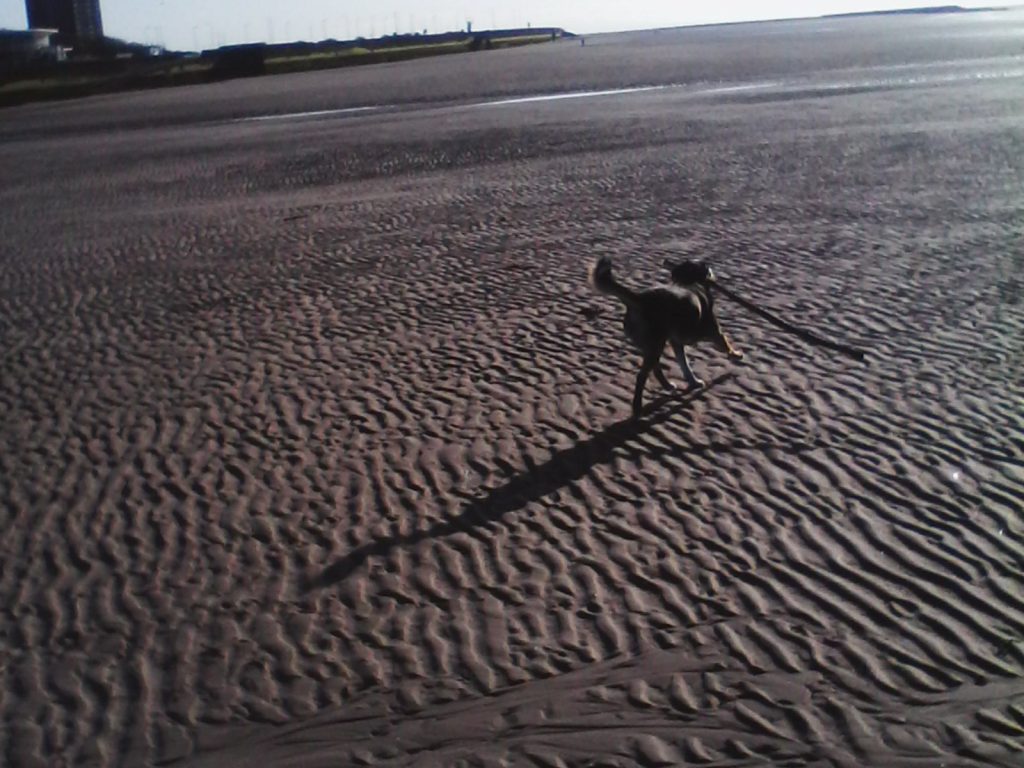
Nowadays, Mabs is calm around people, even crowds of people in stations or on trains, she is easy and responsive off the lead on the beach or in parks where appropriate (i.e. well away from people – and children in particular – playing ball). I am extremely confident with her recall.
She has become a huge help to me when we are out walking, particularly when we are crossing roads. She will always stop at a kerb and will not cross unless I say so, and will actually override me if she hears or sees something she is not sure of. She has already stopped me from walking in front of electric cars and e-bikes a number of times. And if there are obstacles on the pavement, she will stop and wait for me to tell her what to do. Most of the time, I can see big obstacles, but sometimes there are things that I miss (including wheelie bins if I am not concentrating!). But Mabs is keeping me safe.
But how did we ever get this far? A lot of love and patience, some help from medication and, as I said, a couple of training methods. After the behaviourist had seen Mabs and when we were only making very slow progress after a month or so, the behaviourist reluctantly suggested that we should try medication. So I contacted my vet and we started Mabs on L-tryptophan, which is in many over-the-counter calming tablets – the sort you use for fireworks night. These seemed to make little difference, and after another month or so the vet suggested using Selgian, which is often used for anxiety in dogs. The combination with L-tryptophan (KalmAid) seemed to take the edge off Mabs’ behaviour and, importantly, allowed her to calm down and rest between exercise and walks. It certainly didn’t resolve all the problems – or indeed any of them. It just allowed the hard work of training to actually take effect. And over the past year we really have tackled pretty well everything.
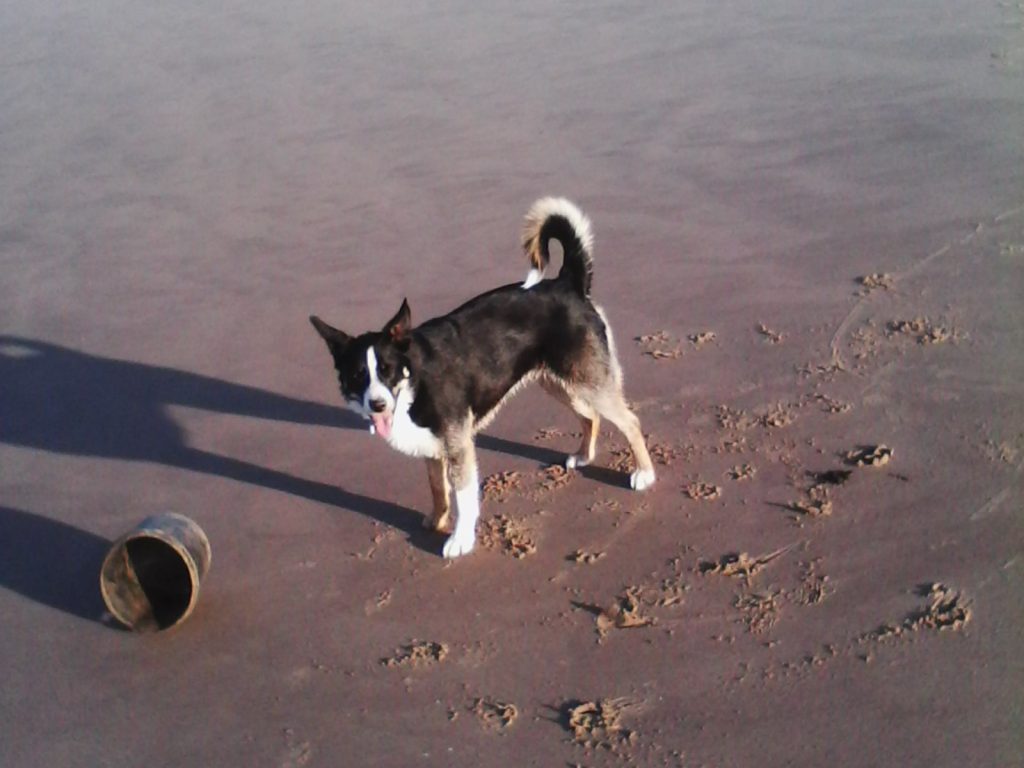
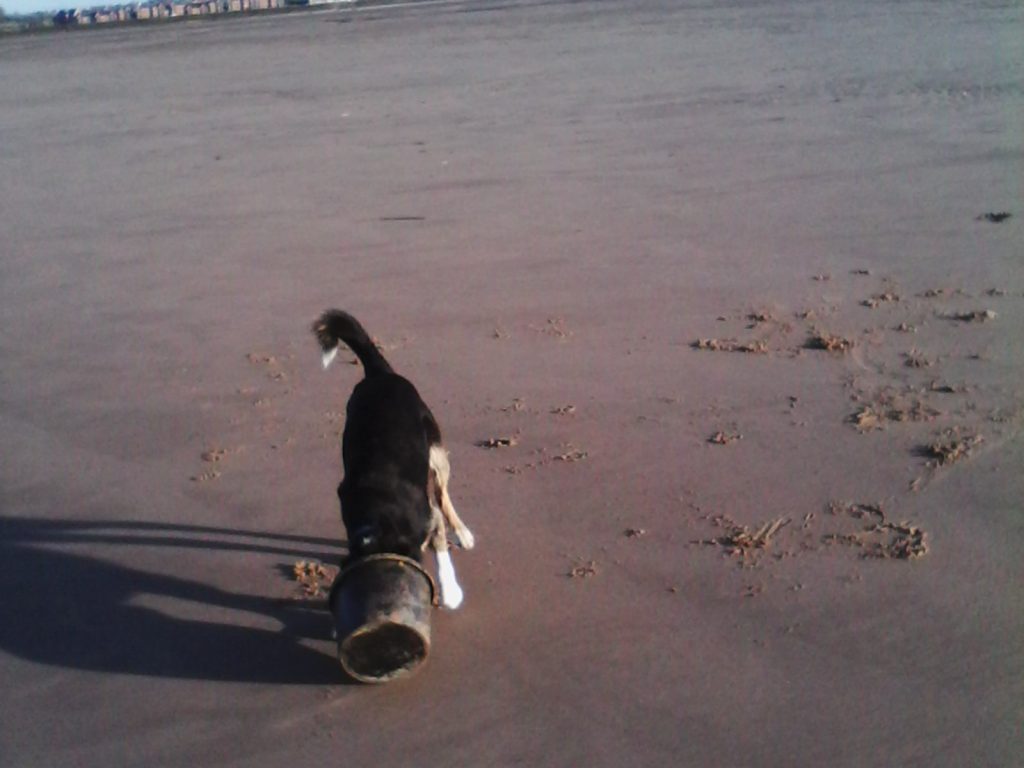
So what was the big training trick?
Before I describe how we have tackled most of the issues, a disclaimer. I am not a behaviourist. I am not even a hugely experienced dog owner. If you have difficult behavioural problems with your own dog, consult a professional. They really can help you.
Firstly, if you want to train your dog – even a dog without behavioural issues – you have to be there for them when you are training them. Leave your phone at home or tell people you will call them back. Your dog expects your full attention. For me, I only carry a phone for emergencies (an old clamshell with buttons) and only a couple of people know the number. If someone wants to talk to me, that’s what the landline is for. When I am out with my dog, I am there for her and she should be able to expect that from me.
Ah, I have digressed. The trick: It’s all about marking and rewarding. The first thing to do is to establish a “marker” word or phrase. This is the phrase that tells your dog that (s)he has been good and is going to get a treat. I chose “good girl”, which wasn’t the best choice, but I’m stuck with it. Other people use things like “yesss” or “well done”. The important thing is that whenever you use the marker word, your dog gets a treat. Always. That’s why “good girl” wasn’t the best choice, as I often want to say “good girl” to Mabs without rewarding a specific behaviour. Whatever word you use, be consistent. Teach it in the house before you try to start using it to tackle difficult behaviours. Start by simply calling your dog’s name to get her/his attention and reward her with the marker word and a treat when (s)he focusses on you. Then use the marker with all the commands they know, but always follow the marker with a treat. After a while, you can start delaying the treat a little (not more than a couple of seconds) so that you say the marker and your dog immediately looks at you as if to say (where’s the treat then?). When your dog absolutely knows that the marker word means a treat is coming (this may take a week or more of hard work), it’s time to start using it with difficult behaviours.
This method of behavioural training works best with very predictable behaviours, for instance traffic or cyclists or joggers, but can be adapted for less predictable behaviours. Also, it is easiest to deploy this method if you can manage to keep a distance from the thing or event that will trigger your dog’s behaviour. So, when I was working with Mabs on being calm with traffic, I used to walk her down to a road with occasional traffic alongside an open field. This was absolutely ideal. First, I had to establish exactly how near we could get to traffic without Mabs reacting. It turned out it was about 15 – 20 yards or so. So we walked along the field at about that distance from the road, and every time a car approached and Mabs didn’t immediately react, I said “good girl” and she turned to me for a treat while the car went past. That way, she began to associate cars going past with getting a treat. Then, over a period of weeks or months, you can gradually walk closer to the road and finally on the pavement without your dog reacting. That’s the theory, anyway.
In reality, particularly when you start, you often run into the problem that you say the marker word and your dog still reacts to the trigger (whatever it is – cars, people, cyclists, dogs) and then turns to you for a treat. And you still have to give the treat. You have used the marker word, so your dog gets a treat. Always. Or you can mark and treat and your dog then reacts to the trigger. This is the bit that I found difficult to understand when I was working with Mabs and traffic. Ideally, you will always be rewarding good behaviour, but sometimes it just doesn’t work out that way. Maybe you gave the treat too early. Maybe you were too close to the trigger. Maybe … It doesn’t matter. You get better at treating your dog at the right time and whatever happens, your dog always gets a treat when the trigger event happens.
And ultimately, Mabs began to turn to me the moment she heard a car coming as if to say “where’s my treat, then?”. It took a couple of months of gradual familiarization and marking and treating before Mabs became more or less calm with traffic, but it has only been over the past month or so that she has finally begun to cope with the most difficult situations (wet roads when the cars sound so different and being stuck on traffic islands between two halves of a pedestrian crossing). But she is there now, and any reaction she may show is pretty half-hearted.
Which is all very well, but you can’t always get space between your dog and the trigger (for instance pedestrians on pavements). In such cases, you can use a similar approach that involves making a huge fuss of your dog when the trigger event occurs, marking the fact that she isn’t reacting and treating and fussing her. Also (with this particular behaviour), warning the people that your dog is “a little nervous”. This tends to make them give your dog a wider berth. And again, your dog will gradually learn that people walking past is not so bad after all, as she gets a treat out of it.
Unfortunately, I can’t link to the Dogs Trust information on this method, as it’s not in the public domain, but here’s a page on an American site that explains much the same procedure.
But, of course, if you are struggling with potentially dangerous behaviour from your dog, muzzle train it, muzzle it and seek the help of a professional. Mabs wore a muzzle for a short while when we started on her training, but we were soon able to do without it.
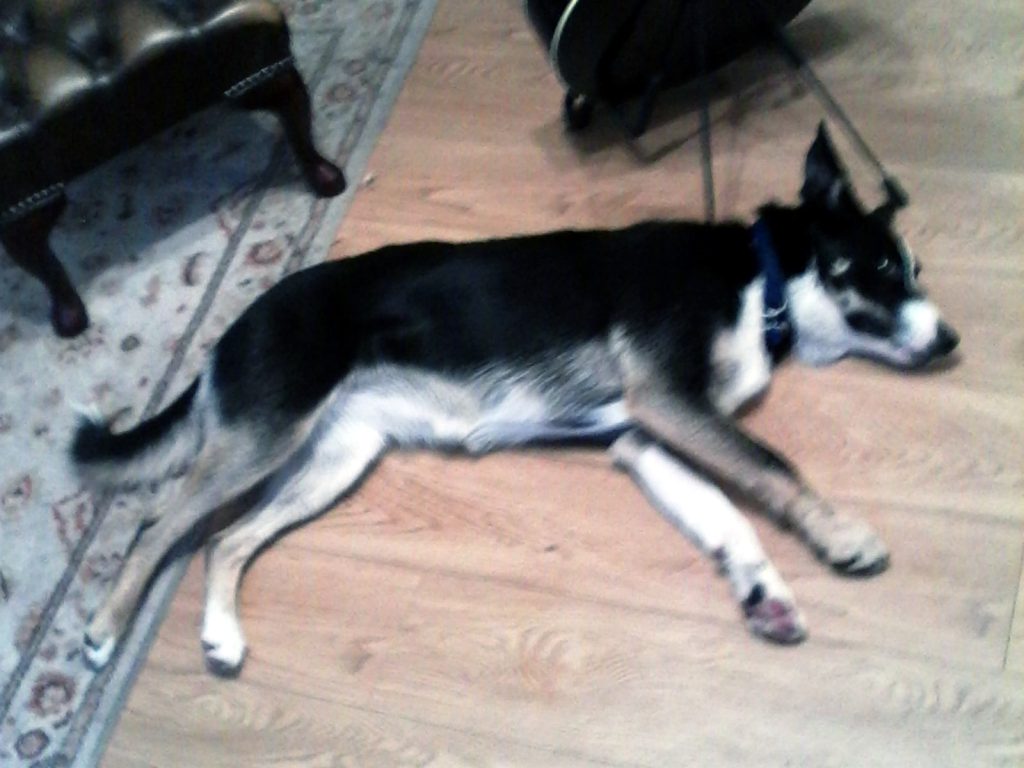
And now? Mabs is now 21 months old and is generally calm and well behaved. She’s very responsive to commands and many people comment on how well behaved she is. She is gradually getting better with other people playing ball games and very rarely shouts at anybody. I am very relaxed about taking her out, and that is, of course, being transmitted down the lead.
She still has some very strange behaviours at home, but they aren’t particularly alarming or worrying. The oddest by far concerns the rubbish bin in the kitchen. I have a dual bin, one side for normal waste and one side for recycling. But the two sides are identical. When I throw something into the waste side, she will perhaps prick her ears up if she is lying down, but that’s about it. If I go to throw something in the recycling side, she starts chasing her tail and yapping, then runs into the garden and goes to her special tail-chasing corner and announces to the street that I am throwing something into the recycling bin. Go figure! But even this isn’t quite as loud and intense as it was. I think she will grow out of it.
She is still on medication, and the vet and I are both agreed that we will only start tapering off the medication when she has overcome all her demons, and I expect that to be within a few months.
The moral of the story? Well, there are a couple of things. If you give a rescue dog a new home, be prepared for the fact that it may turn out to be very hard work for a very long time. And, of course, most behavioural issues with dogs can be resolved with lots of love and affection. But not all of them.
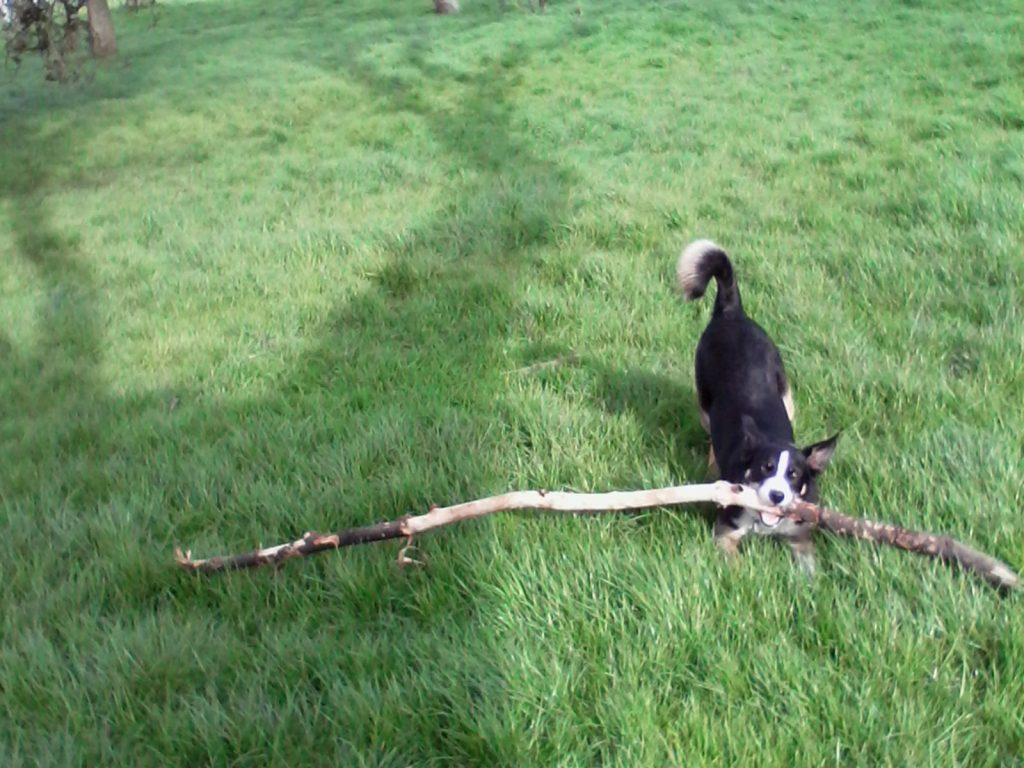
Oh, and if you are wondering what is going on with those ears, so was I. I always thought that she was crossed with another breed, possibly a Kelpie. So I had a DNA test done. 94 % short-haired border collie, 2 % Australian coolie, 2 % Australian cattle dog and 2 % Fijian street dog (which I assume is another way of saying “antipodean mutt”). Seeing that the kelpie was the ancestor of the koolie and the cattle dog and that the kelpie came from the short haired border collie and the local dogs, I reckon that my guess of border collie with some kelpie wasn’t far off. Some of the breeders in Wales (where she came from) have been putting kelpies into the line, so that makes sense.
Mabs has become very dear to me indeed and has overcome all her anxiety of me. She really can be very affectionate when she wants to. She still has her foibles, but so do I. I do hope that we both have a good few years of healthy romping over the beach and the parks together!
Edit:
Quite bizarrely, I met another dog walker a couple of days ago with a 4-year old short-haired collie. As we were talking, it became clear that both dogs have very similar issues, particularly with people, i.e. generally okay with women, tolerant of men with dogs and very anxious with “stray” men (without dogs). And a number of other foibles coincided as well. And I thought I had a singularly strange dog!